In the week preceding our Nation's birthday, the all-American, Edison Pen Company debuted two new materials to their production line of fountain pens that are available to their network of esteemed retailers (like us!). One was a rich, subtle color in the larger Collier model, which was named as 2011's Goldspot Pen of the Year, called Burnished Gold.
The second finish is the topic of this blog post and review - The Edison Pearlette Lapis Lazuli.
Let's check out the video review we published a few weeks back. We unbox, fill and write with the Edison Pearlette Lapis Lazuli with an 18kt gold nib.
The Pearlette is the smallest of the Edison pen models, but by no means is a pocket pen like a Kaweco Sport. Here, we see the pen model comparison from the Edison Pen Co website :
The size has a vintage feel, as many models and brands manufactured pens of this size back in the mid 20th Century. I compare it closely with the size of my Parker Vacumatic, which measures about 5 7/8" posted.
While this Vacumatic would be considered to be around the "standard" size of pens made by Parker at the time, the Pearlette is seen to be a diminutive design in the modern age of fountain pens. For an average hand, this pen works is still a good fit. I would strongly recommend it for anyone that prefers a smaller pen with a thinner grip section. If you prefer a heavy hitter like the Collier, then the Pearlette would not be an enjoyable pen to hold.
Edison Pearlette Specifications
Nib : #5 Size, available in stainless steel or 18kt gold.
Filling System : Cartridge or Converter
Cap Diameter : .515in
Barrel Diameter : .515in
Length Capped : 5 3/16in
Length Uncapped : 4 3/4in
Pen Weight : 18g
Barrel only Weight : 12g
As one would expect from a quality Edison fountain pen, the attention to detail on the fit and finish of this pen is remarkable. The Lapis Lazuli acrylic is polished to a high luster. The cap threads on to the front section securely and posts on the back as well. The standard Schmidt converter fits snugly into the section to make filling the pen effortless.
The Lapis Lazuli material itself is splendid to behold. I argue it looks even better than the precious gemstone that carries its namesake. The rich, saturated blue has a shimmer and sheen when held up to direct light. The flecks of marbled acrylic are highlighted with gold veining that, matched with the gold clip and bi-color gold nib, create an elegant picture of a pen that carries the heritage of American-made writing instruments.
The smaller, #5 size nib doesn't have the grandiosity of the #6 nib that is standard on most other Edison fountain pens, but the performance is "write" on par. The 18kt gold nib that was used for this review flows nicely with a slight bit of feedback. The gold responds to the amount of pressure you put on the point, but I wouldn't recommend doing any flexing.
The Edison Pearlette is part of the production line of fountain pens, which are available at many fine writing shops (both online and brick-and-mortar). The advantage with the production line is the pricing. A custom Edison that is ordered directly (in any material of your choosing) will run you at least $250 for a steel nib. One of these production model Edison pens is only $149 for the steel nib and $274 for the 18kt gold nib. For their production line, the Edison Pen Co. usually picks stunning pen materials that appeal to a wide audience. The Lapis Lazuli is certainly no exception. Come check it out on the Goldspot Pens shop and enjoy free shipping on any Edison fountain pen shipped within the USA.
]
This is Part 3 in our series "What's My Pen Worth," where we discuss the details of how to evaluate and successfully sell older writing instruments for their maximum value. In Part one, we show how to accurately identify the writing instrument. Part two gives a checklist for describing the condition of the item.
For this last part, you should have noted the following about your pen :
The brand, model, approximate year of manufacture and country of manufacture.
Whether the pen actually writes and/or can be filled using the filling mechanism.
If a fountain pen, the nib size, material and gold content (if applicable).
The cosmetic condition of the pen, noting and photographing any scratches, dings, dents, engravings etc.
Whether it has the original box and paperwork.
Next, we are looking to get an understanding about the market value of the pen in order to accurately value the piece in your possession.
BONUS - Find out where to sell your pens at the end of this article.
The internet is an amazing tool for figuring out the going price of virtually anything that is sold. Gone are the days of the collectors reference books, blue books or any other printed price guides that assign dollar values to particular collectibles. Not only is that information dated as soon as the ink dries on the paper, it also doesn't take into account the wild bonanza that is the internet marketplace.
You're online reading this article, so you may as well pull up another browser tab or window to get started with your pricing research. Since we know the make & model details from part one, get started by searching the full name of your pen on Google, making sure to include the mode of the pen as well. For example :
"Parker Vacumatic Blue Azure Pearl Major Fountain Pen"
The point to Googling is to find current or completed listings on eBay, retail websites, or discussion board forum posts that match your pen.
Your query should be as descriptive as possible to start. However, if your search is coming up short on listings, then you should eliminate the additional key words to get a more general result.
eBay will most likely be your most helpful tool in this research, as this will be the most richest resource of older, antique items that are being sold by folks just like yourself. Two other specific sites to look at would be Fountain Pen Network's classifieds and the Pen Swap subreddit.
eBay power seller tip : use Completed Listings filter. Just searching an item on eBay will return all the active auctions, showing you starting bids and items that are way overpriced and will not sell. See what items have sold and their final sell price by check-marking the Show only : Completed Listings filter in the search menu options. Your query will then only show the listings that have been successfully sold and for what value they were sold for.
It is important to note the conditions of the items that are listed. Are they similar to your pen? Are they working or for parts? Are they being shipped from outside of the US or locally? Before getting excited that your pen may be worth hundreds or thousands of dollars, read the description of the auction listing to see if is being sold with the original box or if there was anything special about the item that differs from yours.
Price within the Neighborhood
Consider this process like an appraisal for a house. An appraiser heavily weighs the recent sale values in your particular neighborhood to determine the value of your entire property. The condition of the house itself matters significantly, but you need to understand the price "neighborhood" first and foremost.
Even if you find only one listing for a pen that is similar to yours, it would still be possible to gauge an appropriate value for your pen. Consider the condition value scale we diagrammed in Part 2 :
Brand new, in box with original papers - $$$$$ Like new, recently restored, gently used - $$$$ Used, working, with some cosmetic issues - $$$ Not-working, dings, dents, but all pieces intact - $$ Broken, for parts - $
Hypothetically, lets say the pen you have is in good condition and writes well. If the listing you had found is missing a clip and doesn't write, but still sold for $30, you could easily price your pen in the $80 range since it is higher in the condition value scale.
If you're lucky enough to have a pen that is brand new in box or hardly used, you're always going to be looking at the top-end of the price spectrum. It is rare for pens that are 20 + years old to be brand new, with original box and paperwork. However, this doesn't mean that you should value your pen 4 or 5 times higher than a gently used version. It still needs to be within the same ballpark.
When there are multiple auctions or completed listings that are in varying conditions, it is easier to determine the value. If there are several pens listed with the same condition as yours, simply take an average of the auctions to get your approximate dollar value.
BONUS : Where to Sell your Pens
Now that you're armed with all the information you need about your vintage pen(s), you may decide to liquidate their value for some cold, hard cash. If you followed the instructions in this article to find the market value for the pen, you should have all the details you need to successfully find a buyer for your pens.
Option 1 : eBay
eBay is one of the largest websites that deal antiques and collectibles. This is a great place to start to find a market value for your pens, and you should be able to find a buyer just as easily and get a good value for your pens. You can easily add images, write a description (using your notes accumulated during your research) and price your item with shipping costs.
Pros : Large audience of buyers. Great visibility on Google. User ratings and eBay dispute system.
Cons : You're giving roughly 15% of your sale to eBay and Paypal in fees.
Option 2 : Private Classifieds
Listing on a forum like Fountain Pen Network or Craigslist usually comes without any fees, but you have to have faith that the other person you are dealing with isn't going to scam you. Take extra precaution, because the anonymity of the internet is at play in these instances since particular users do not have any reputations to uphold (like eBay feedback) and there is no dispute system to handle transactions gone awry.
Pros : Direct sale gets cold, hard cash without any transaction or commission fees. Listing on a pen-related discussion forum can attract many interested buyers.
Cons : No reputation management or dispute resolution.
Option 3 : Retailer / Reseller
Certain pen companies, like Fountain Pen Hospital, deal in vintage pens as well as modern pens. You would contact them directly, send information regarding all the pens you have to offer, and they would give you a quote on what they would pay for your pens. If you have a number of pens to offload in a fairly short amount of time, this may be an ideal option if you don't have the time to individually list them.
Pros : Quick and straightforward sale. Work directly with a reputable company. Good option if you have a lot of pens that need to be sold in a short timeframe.
Cons : The company needs to make a profit on your sale and you may end up getting 50% or less of the market value of your pens.
=============
We hope you found our three-part series on "What is My Pen Worth" informative and useful in determining the value of your pen collection. If you have additional questions or other recommendations to help other pen enthusiasts, please feel free to comment below.
-------------------- Disclaimer : Although I'd love to help every one of you that are trying to do your own detective work, there's not enough time in the day and we're not official appraisers of pens, nor do we purchase our inventory from private sellers.
]
This is Part 2 in our series "What is My Pen Worth?," where we discuss the details of how to assess and successfully sell older writing instruments for their maximum value. If you missed part one, click here to see how to make an accurate ID of your pen.
Now that you've successfully identified your pen's make and model, your next task is to give an honest evaluation regarding the condition of the pen.
Why be concerned about the condition?
On the value spectrum, it matters greatly whether the pen in question is new with the original box and papers or if it is in pieces and requires restoration. Here is a simple chart to give you an idea of value based on condition.
Brand new, in box with original papers - $$$$$ Like new, recently restored, gently used - $$$$ Used, working, with some cosmetic issues - $$$ Not-working, dings, dents, but all pieces intact - $$ Broken, for parts - $
Hypothetically speaking, let's say that "Pen X" recently sold on eBay for $100. It was in mint condition, in the original box with paperwork. You have a "Pen X" that you would like to figure out the value of. It is the same make & model, but it is missing the box and still writes nicely. It would probably be worth about $80. If it has a few cosmetic scratches and dings, but still works, it would probably be worth about $65. If it isn't working and has dings & dents, but all the pieces are there, it might go for only $30. If the same pen was broken, missing parts or in otherwise poor condition, it may only fetch $10-$20, depending on what parts are intact.
That is a hypothetical scenario, but I hope you see the point. The perceived value of an auction can change greatly if you can accurately gauge the condition of the pen rather then list it blindly with a simple picture of a pen that you're unsure if it works or not. Even a mention of including the original box can increase the value of the pen by 15% over an auction that doesn't include the box.
Seriously, What is a Box Worth?
Having the original box and papers that accompany a writing instrument is a big deal, especially in the vintage market. These older boxes and paperwork give the collector a clear window into the world of yesteryear when that pen was originally sold. Even magazine advertisements for vintage pens can sell for $5-$10 a page.
It's always a good laugh to see how much the pen was originally sold for back in the 40's and 50's. Adjusted for inflation, they were still a significant expense!
If you have a box that came with the pen, you would want to make sure that the box actually belongs to the particular pen you are looking at. See if the brand names match. Look for any paperwork that may match with the make and model of the pen in question. Check other auction listings online to see if others are selling the pen with the original box. Does that box match yours? Note the condition of the box and be sure to photograph it with the pen inside if you are planning on listing it for sale.
4 fully functioning Parker Vacumatics from the 1940's
Does the Pen Write?
The working / not-working part is the most important aspect that is the easiest to test. However, not many laypeople know how to test a vintage fountain pen to see if it is functioning. That is where the additional detail research we talked about in part one of our series comes into play.
If you've done your homework and looked at what type of fountain pen filling system you have (lever, button, vacumatic, snorkel or otherwise), you should be able to find out how to test if your pen can be filled or not. If you need visual help, Google "how to fill a FILLING SYSTEM fountain pen," where you replace the words "filling system" with the type of filling system your pen has. Most likely, someone has done a YouTube video on the subject and will give you a visual step-by-step to fill the pen.
A simple test to see if the pen fills with water can determine whether your pen's filling system is working or in need of repair. Pens that are found after years and years of being neglected will most likely need a replacement sac or other part that usually disintegrates or degrades over time. If you're lucky, the pen may fill up and hold water just fine.
If the pen passes the water test, the next test would be to ink it. Find a safe ink made for fountain pens. Nothing fancy, just something safe to test with, like Waterman blue. Expel the water from the pen and fill with a small bit of ink. How does the nib write? Is ink coming out of the tip smoothly? Is there any hesitation, stopping, leaking or anything else that seems odd with the writing experience? Of course, it takes an experienced hand to understand the nuances of writing with fountain pens, but you should be able to get a gist for whether the pen will actually write or not.
Keep notes of how the fountain pen wrote so you could include it later for an auction listing.
In the case of a ballpoint pen, rollerball or mechanical pencil, you may have to replace the cartridge that was installed in the pen. Sometimes, the older cartridges may be difficult or impossible to obtain, but there is usually a modern version of the cartridge that would be reverse compatible.
The general rule is, if it can write correctly from the get-go, then it would be valued higher by the potential buyer or collector.
Waterman 14kt Ideal Nib with Flex - 1940s
How Does the Pen Look?
While looks aren't everything, the cosmetic condition of the pen matters a great deal to collectors. Look at the pen, preferably with a loupe or magnifying glass, and note any major dings, dents, scratches or cracks in the surface of the material. Inscriptions other than the typical brand markings (like the previous owner's engraved initials) should also be notated. Unfortunately, any engraved modifications usually lowers the value of the pen.
"VACUMATIC" Imprinted on barrel
If you are intending to list this item for sale or auction, it does help to photograph any dings, dents or engravings that may be on the pen. A macro lens can clearly capture the up-close, fine details. Note them as well to include in the listing description.
You can put a little elbow grease into improving the condition of the pen, which, in turn, increases its perceived value. Metal trims and certain resins can be polished up using some Simichrome polish to remove minor imperfections. I've used the polish with great success on metal trims and clips to resurrect the shine that was hidden by years of tarnish. However, unless you're a professional craftsperson, I would not recommend to take a full restoration into your hands. You could do more damage to the pen, which would further lessen the value.
Restoration (top photos before, bottom photos after) of Parker Vac
Particular points to look for in assessing the cosmetic condition of a pen:
Are there any parts missing? (Clip, cap, blind cap, lever box, converter, etc)
Are the nib tines aligned and straight, or bent and misshapen? (this would usually effect the writing quality mentioned previously)
Are the imprints on the nib and anywhere else on the pen crisp? Or are they faded / illegible?
Is the clip strong or loose and wobbly?
Does the cap thread on to the top of the pen easily?
If there are any transparent areas of the pen, can they bee seen through clearly?
Parker 45 Classic - Notes for Auction
Note Everything
Along with your notes from the first step in identifying the pen (including he brand, make, model and approximate year of manufacture), you should also note the nib type / writing mode, and have a full list of condition notes. All of these notes will help tremendously in writing a full description for your item listing if you were to choose to auction or sell it.
Now that you're armed with the information regarding the condition of the pen, you can take the final step and determine the current market value of your pen.
If you have some suggestions or particular points about pens that you look for when determining the condition of your pens, please feel free to drop us a note here in the comments.
-------------------- Disclaimer : Although I'd love to help every one of you that are trying to do your own detective work, there's not enough time in the day and we're not official appraisers of pens, nor do we purchase our inventory from private sellers.
Well, that might be exaggerating a bit, but you may have some gold on a pen that could be quite valuable.
Every day, collections of pens are either rediscovered by the current owner or inherited by someone who may not be knowledgeable about the writing instruments they now possess.
The pens are old. You know that much for sure. But, how old and, more importantly, how valuable are these writing instruments of yesteryear?
Vintage pens, from the layperson point-of-view, can be overlooked as a defunct device in the current era of mobile phones and touchscreen tablets. Unless you're a pen aficionado, it is not easy to identify and place a value on a writing instrument.
That's where this article aims to help.
Although we're a retailer of modern pens, we have over 10 years of experience and have seen both sides of the market - customers who are hunting for discontinued, out-of-production pens and folks who are looking to liquidate their collection of pens. There is a healthy demand on the web for vintage and discontinued pens.
If you list the pens as an estate sale or lot without doing your proper research, you could be leaving major dollars on the table that could have been easily in your pocket.
Relying on the collector's market or a reseller to pay a fair value for your writing instruments is a folly that will leave you with a fraction of the value for your collection.
The best way to figure out the value of your older pen is a 3-step process :
Identify the make, model and the year of manufacture (estimated).
Determine the condition
Gauge the current market value of the item.
We're going to talk about step one, which is a question we get often - What is this pen that I have?
Before we get started, here is a simple diagram to get you familiar with the parts of a pen.
Parker Vacumatic Fountain Pen Basic Diagram of Named Parts
Yes, even with pens, brand name is everything. Demand for Parker, Sheaffer, Waterman and Esterbrook pens are high in the vintage market. Best case scenario is that you have the box and original paperwork and can easily find out what the brand, model and approximate year of manufacture is. However, if you don't have that information handy, check the clip, nib or cap band for the brand name. Most vintage pens will also have an imprint on the barrel with the brand name and perhaps a date code or other signifying marks that will make it easier to identify the pen.
Step 2. What's the Model?
Simply saying that I have a vintage Parker pen for sale doesn't cut it for most collectors. There's a large variety of different models that vary in value. Knowing your Vacumatics versus your Duofolds and 51's will help in getting a ballpark idea of the value.
Now that you know the brand, take to Google Image search. Enter a search "BRAND NAME pens". Alternatively, you may want to try the following searches :
BRAND NAME vintage pens
BRAND NAME MODE (where mode is ballpoint, rollerball or fountain pen)
BRAND NAME + other imprint text that is found on pen
The idea of this google search is to find images that match the pen you are researching. Then, once you find the image that matches, click on it, then click on "visit page" to see the webpage that is hosting the image. Most likely, that site will have more information, including the make and model of the pen you are looking for.
Step 3. Devil in the Details
Now that you have a make and model, it's time to bone up on your pen history. That's where it will be helpful to have a resource like Richard Binder's website or a brand-specific website like Parker Penography to find more details about the history of the particular pen. The key is to find more information about the materials of the pen, the year manufactured and the filling system.
Some sellers on eBay or vintage resellers might also have a solid amount of information, including dimensions of the pen, idiosyncrasies with rare variants and common problems that may be encountered when restoring the writing instrument.
If you're stuck on any of the steps, don't worry, there's help to be had.
Take a nice photo of the pens you are looking to identify. Sign up as a user (it's free) to Fountain Pen Network, Reddit /r/fountainpens or FP Geeks. Post the pic on one of those discussion board style sites with a sincere plea for help to find the identity of your pens. The kind and knowledgable folks that frequent those sites are usually very quick and helpful to lend you their expertise.
At this point, you should have the brand name, model and should have an approximate idea of when the pen was made, what type of filling system it has and some other tidbits that will help you in the next step, which is Part 2 : determining the condition of the pen.
Do you have any comments or tips on how you go about identifying an unknown pen? Please share them below in the comments.
-------------------- Disclaimer : Although I'd love to help every one of you that are trying to do your own detective work, there's not enough time in the day and we're not official appraisers of pens, nor do we purchase our inventory from private sellers.
To follow up on the teaser postcard that we are sending in our current shipments, Parker has shared their master plans for the fall debuts of new Duofold, Urban & IM models that are designed after vintage Parker styles.
Duofold : A Classic Redefined
The Duofold is gaining three new permanent extensions to the line that are inspired by the Parker Duofold of old : Big Red, Lapis Lazuli & Ivory. These acrylic resin styles are trimmed in gold plated appointments and are available in a twist-action ballpoint pen, capped rollerball and two sizes of fountain pen. The larger Centennial size and the International size are both filled by cartridge or cartridge/converter (included). The nib is a big, two-toned, 18kt solid gold beauty, fashioned with the Duofold Spade graphic.
The estimated price ranges on this set are $280 for the ballpen, $330 for the rollerball, $450 for the international sized fountain pen & $550 for the centennial. No doubt that the popularity of these vintage colors will come through for Parker in reintroducing a fan favorite in the Duofold.
Parker's Vacumatic for the 21st Century
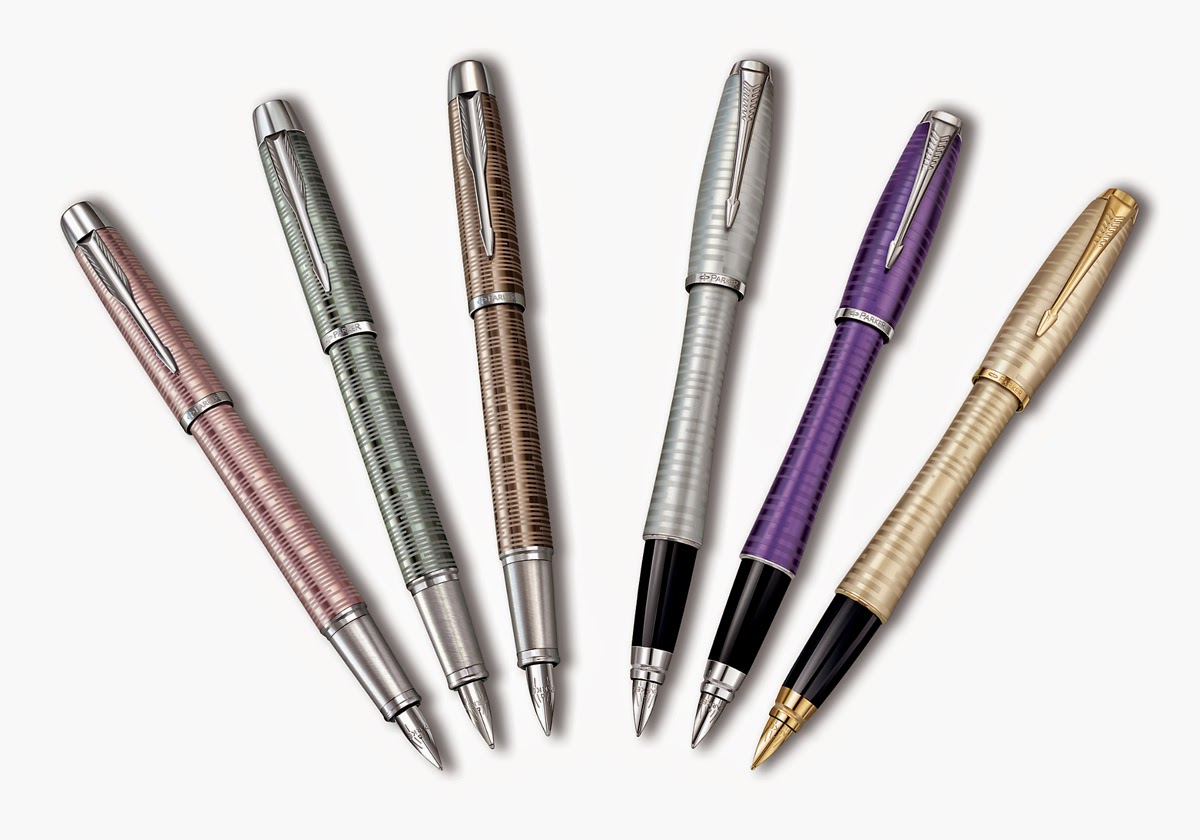
The Parker Vacumatic stands as an emblematic style of the Parker Pen Company and is one of the most highly sought after vintage pens for collectors. This Fall, Parker debuts six new finishes in the IM & Urban lines inspired by the Vacumatic's alternating band design. While the Vacumatic was originally built with laminated plastic, these new pens are styled using aluminum to give a modern look to the design.
The IM & Urban lines are Parker's more approachable, entry-level category of pens. Each new finish will be offered in a ballpoint pen, rollerball or fountain pen. Please note that the fountain pens will be using a cartridge/converter filling system and will not have the Vacumatic filling system (that would make too much sense, right?). The fountain pens will be fitted with steel nibs in medium point size only. The price ranges from $37 for a ballpen to $75 for the fountain.
All pens will be on sale on our site the moment that they arrive. To receive an update on when they will hit the store, please sign up on our e-mail newsletter list so you can be first to know!
We received this teaser card that will be given away in outgoing orders until we run out.
Coming September 2014, Parker is looking forward to the release of new Duofold pens that will revive historical colors. Since no further information is available at this time, we can only speculate that the colors will include or be similar to the ones shown on this vintage ad post card.
Would it be too much to ask if they were priced and built like the vintage Duofolds?